
What are the limitations of deploying a Time Server in an organization?
In the previous section, we explored how to select a Time Server that is suitable and cost-effective for organizational use (you can read more here). In this section, we will discuss the limitations of deploying a Time Server within an organization and the factors that affect its optimal performance.
To ensure accurate and reliable data in compliance with the Computer Crime Act B.E. 2550, service providers are required to synchronize the clocks of all service-related devices to accurately record computer traffic data. This information serves as critical evidence when investigating log files.
For this reason, the demand for implementing Time Server systems in organizations has increased. However, deploying a Stratum-1 Time Server comes with certain limitations. It must be installed in an open area with a clear view of the sky to ensure optimal satellite signal reception. The more satellites it can detect, the more precise and faster the time and positioning calculations will be.
Typically, a Time Server system is installed within the organization, while the signal receiver is placed outside the building using cabling. This setup ensures that the receiver can obtain the strongest possible satellite signal. However, there is a constraint: the distance between the receiver and the server must not exceed 100 meters, according to the EIA/TIA 568 standard, measured from end to end of the cable. Additionally, the receiver should not be installed near other satellite dishes or lightning protection systems to avoid signal interference.
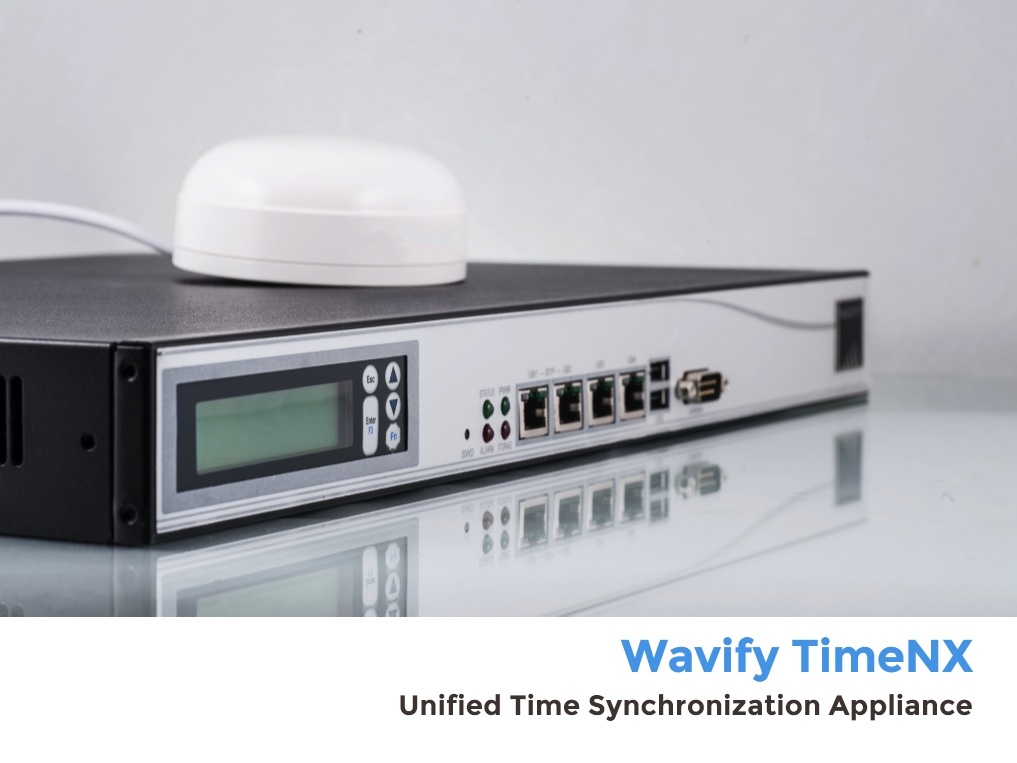
In some locations, there are restrictions that prevent installing the receiver outside the building, requiring it to be placed indoors instead. For Wavify TimeNX, there are receiver options suitable for both indoor and outdoor installations. When installed indoors, expert teams will conduct a site survey to determine the most appropriate placement. Typically, the receiver is mounted on indoor glass surfaces to achieve signal quality comparable to outdoor installation.
The following table summarizes the limitations of Time Server installation to ensure optimal performance:
<